Latest News
Loading news articles...
The automotive industry is undergoing its most transformative period in a century. Here are the key trends reshaping how we drive, build, and think about cars.
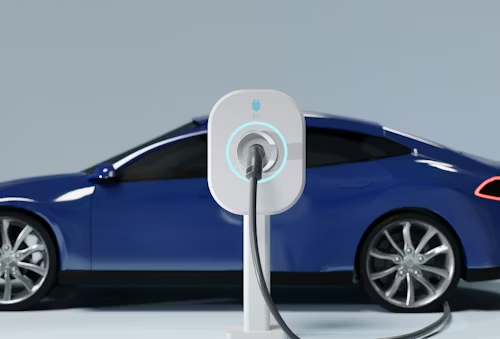
Electric vehicles are no longer a niche category — they are rapidly becoming the mainstream choice for consumers worldwide. With over 320 EV models now available across all segments, from compact city cars to luxury SUVs, the transformation is undeniable.
Battery technology has made significant leaps, with solid-state batteries on the horizon promising longer range, faster charging, and improved safety. Meanwhile, government incentives and tightening emissions regulations continue to drive adoption across major markets including North America, Europe, and China.
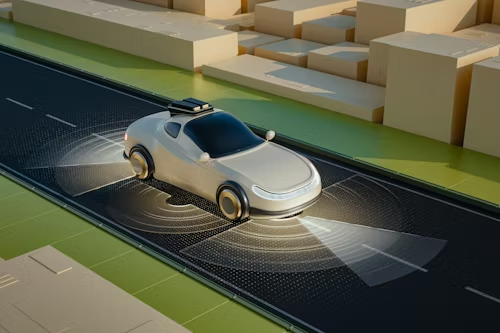
Self-driving technology continues to evolve from highway assistance systems toward fully autonomous urban navigation. Level 3 autonomy is now available in several production vehicles, allowing hands-free driving under specific conditions.
The race toward Level 4 and Level 5 autonomy involves more than just technology — it requires new regulatory frameworks, infrastructure upgrades, and public trust. Companies like Waymo, Cruise, and traditional automakers are investing billions in sensor technology, AI algorithms, and real-world testing to make autonomous vehicles a daily reality.

Modern vehicles are evolving into rolling computers, with the average new car containing over 100 million lines of code and more than 100 electronic control units. 5G connectivity is enabling real-time vehicle-to-everything (V2X) communication, allowing cars to share data with infrastructure, other vehicles, and cloud services.
Over-the-air updates now allow manufacturers to improve vehicle performance, add features, and fix bugs remotely — much like your smartphone. This shift is fundamentally changing the automotive business model, with software-defined vehicles creating new revenue streams long after the initial sale.
Hand-selected by our editorial team — the stories that matter most this week
Major automakers including Toyota, Volkswagen, and Hyundai are pouring billions into securing battery mineral supplies and building gigafactories across multiple continents. The strategic shift aims to reduce dependency on single-source suppliers and ensure production capacity meets soaring demand for electric vehicles through the end of the decade.
By Michael Torres • June 1, 2025
The concept of a "software-defined vehicle" is transforming cars from static machines into evolving platforms. Tesla pioneered the approach, but now every major manufacturer is following suit. This shift means your car can improve after purchase — gaining new features, better performance, and enhanced safety through over-the-air updates delivered while you sleep.
By Sarah Chen • May 28, 2025
Affordability has been the biggest barrier to EV adoption, but that wall is finally coming down. A new wave of electric vehicles priced under $30,000 is set to hit showrooms starting late 2025, including models from Chevrolet, Hyundai, and several Chinese manufacturers entering Western markets for the first time.
By James Walker • May 25, 2025
After two years of volatile pricing, the used EV market is finally finding its footing. Increased new EV production, improved battery longevity data, and growing consumer confidence are all contributing to more predictable resale values. For budget-conscious buyers, this stability makes certified pre-owned electric vehicles a more attractive proposition than ever.
By Laura Kim • May 22, 2025
Standout models that define the current automotive landscape
From AI-powered driving assistants to sustainable manufacturing, these technologies are defining the future of mobility
Next-generation AI systems go beyond voice commands. They learn your driving habits, predict navigation destinations, adjust climate preferences automatically, and can even detect driver fatigue through steering pattern analysis and eye-tracking cameras.
Modern ADAS combines LiDAR, radar, ultrasonic sensors, and HD cameras to create a 360-degree perception field. These systems can handle highway driving, navigate traffic jams, perform automatic lane changes, and even park themselves in tight spaces without driver intervention.
Leading automakers are rethinking every aspect of production. From recycled ocean plastics in interior panels to solar-powered assembly plants and closed-loop battery recycling programs, sustainability is becoming a core manufacturing principle rather than a marketing afterthought.
The cabin is becoming a living room on wheels. Multi-screen dashboards spanning the full width, 5G-powered streaming, spatial audio with head-tracking, and gaming capabilities powered by automotive-grade GPUs are turning the daily commute into an entertainment experience.
The numbers behind the transformation — data-driven perspectives on where the industry is heading
The global automotive market is projected to reach $1.5 trillion by the end of 2025, driven primarily by electric vehicle adoption in China, Europe, and North America. EVs are expected to capture over 20% of new vehicle sales globally for the first time.
Supply chain normalization following years of chip shortages is enabling automakers to ramp up production. However, new challenges are emerging around critical mineral sourcing, particularly lithium, cobalt, and rare earth elements essential for EV batteries.
Consumer preferences continue shifting toward SUVs and crossovers, which now account for over 55% of global new vehicle sales. This trend is pushing manufacturers to electrify their SUV lineups first, with compact and mid-size electric crossovers becoming the industry's most competitive segment.